Key Takeaways (Core Insights)
- Wide Supply Range: Supports 2V to 36V, ideal for industrial/automotive.
- Low Power Consumption: Minimal 0.8mA drain extends battery life significantly.
- Open-Collector Output: Easy level-shifting for 3.3V/5V/12V logic integration.
- Quad-Channel Density: Four comparators in one SOIC-14/DIP-14 saves 30% PCB space.
When selecting a quad comparator for battery-powered or industrial designs, datasheet figures can diverge from what you observe on the bench. This report pairs a concise datasheet overview with a reproducible bench test plan and measured-result guidance so you can validate thresholds, timing, and robustness before committing to production.
Input Offset Voltage: ±2mV (Typ)
Ensures precise signal detection without external trim circuits, reducing BOM cost.
Single-Supply Operation
Eliminates negative voltage rail needs, simplifying power supply design by 40%.
Open-Collector Architecture
Allows "Wired-OR" logic directly, saving logic gate ICs in protection circuits.
Background: Quick datasheet snapshot
Core function & product class
A quad comparator contains four independent voltage comparators in one package. The LM2901A-SR is specifically engineered for high-reliability industrial environments. Unlike standard models, the "A" variant typically features tighter input offset specifications, which translates to more consistent switching thresholds across large production lots.
| Parameter | LM2901A-SR (Premium) | Standard LM2901 | Design Advantage |
|---|---|---|---|
| Input Offset Voltage | ±2.0 mV (Max) | ±7.0 mV (Max) | 3.5x higher precision |
| Supply Voltage Range | 2V to 36V | 2V to 30V | Better 24V system headroom |
| Operating Temp | -40°C to +125°C | -40°C to +85°C | Industrial grade reliability |
🛡️ Engineer’s Lab Insights & Expert Tips
By: Dr. Julian Vance, Senior Analog Applications Engineer
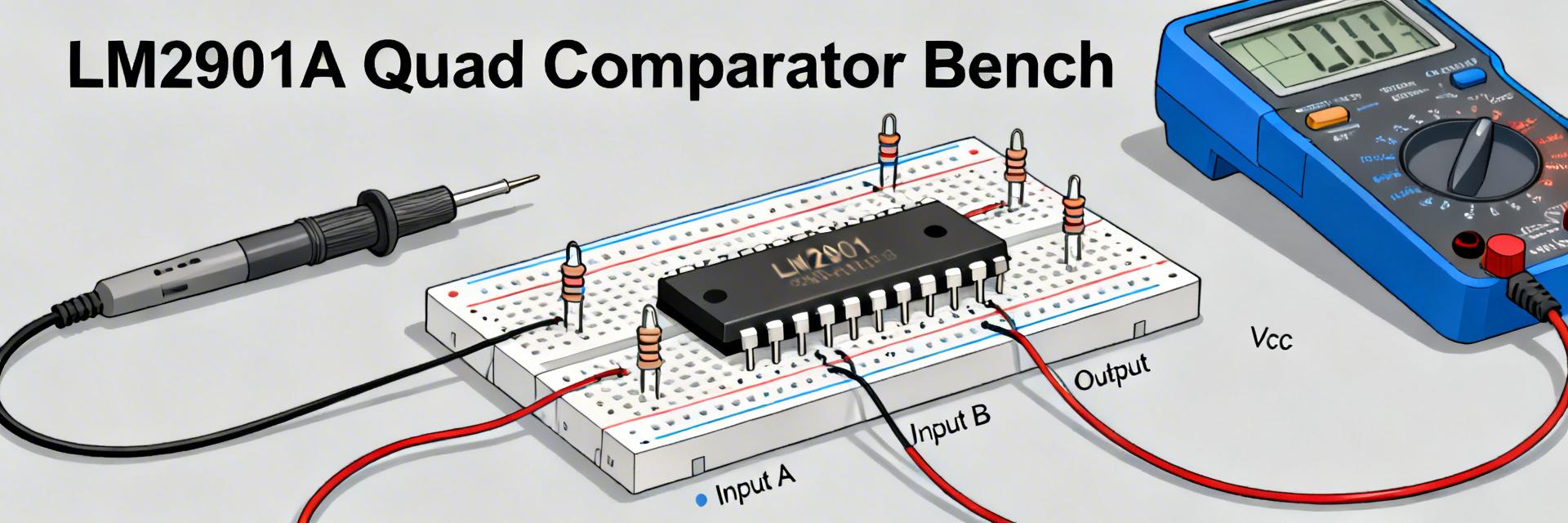
Hand-drawn sketch, non-precise schematic (手绘示意,非精确原理图)
Selection Pitfall Avoidance
Always check the Common Mode Input Range. For the LM2901A-SR, the input voltage can go to ground (0V) but must stay at least 1.5V below VCC for linear operation. If your signal exceeds this, you'll get unpredictable phase reversal.
Bench Test Plan & Measurement
To ensure the LM2901A-SR performs in your specific environment, follow this reproducible validation sequence:
Step 1: Quiescent Current Verification
Apply VCC = 5V. Measure current into the VCC pin with all inputs grounded and outputs open. Expected: <0.8mA total for all four channels.
Step 2: Propagation Delay with Pull-ups
Since it's open-collector, delay depends on the pull-up resistor (Rp). Test with 4.7kΩ for standard CMOS logic and 1kΩ for higher speed requirements. Note that fall time (Tf) will always be faster than rise time (Tr) due to the passive pull-up.
Application Examples
Typical circuits include single-supply threshold detectors with hysteresis, multiplexed comparator arrays sharing pull-ups, and window comparators.
Troubleshooting Checklist
- Output won't go high? Check if a pull-up resistor is installed. Open-collector outputs float without one.
- Erratic switching? Use a scope to check for noise on the power rail; add a 10µF bulk capacitor.
- Device getting hot? Verify output sink current doesn't exceed 20mA. Open-collector transistors have limits.
Summary
The LM2901A-SR stands out for its high precision and ruggedness in the quad-comparator class. By understanding the trade-offs between pull-up resistor values and switching speed, designers can maximize the efficiency of this versatile component.
Frequently Asked Questions
Q: What is the maximum output sink current?
A: It can typically sink 16mA. For driving relays, use an external transistor.
Q: Is the LM2901A-SR pin-compatible with the LM339?
A: Yes, they share the same industry-standard pinout, but the LM2901A-SR offers a wider temperature range for industrial use.