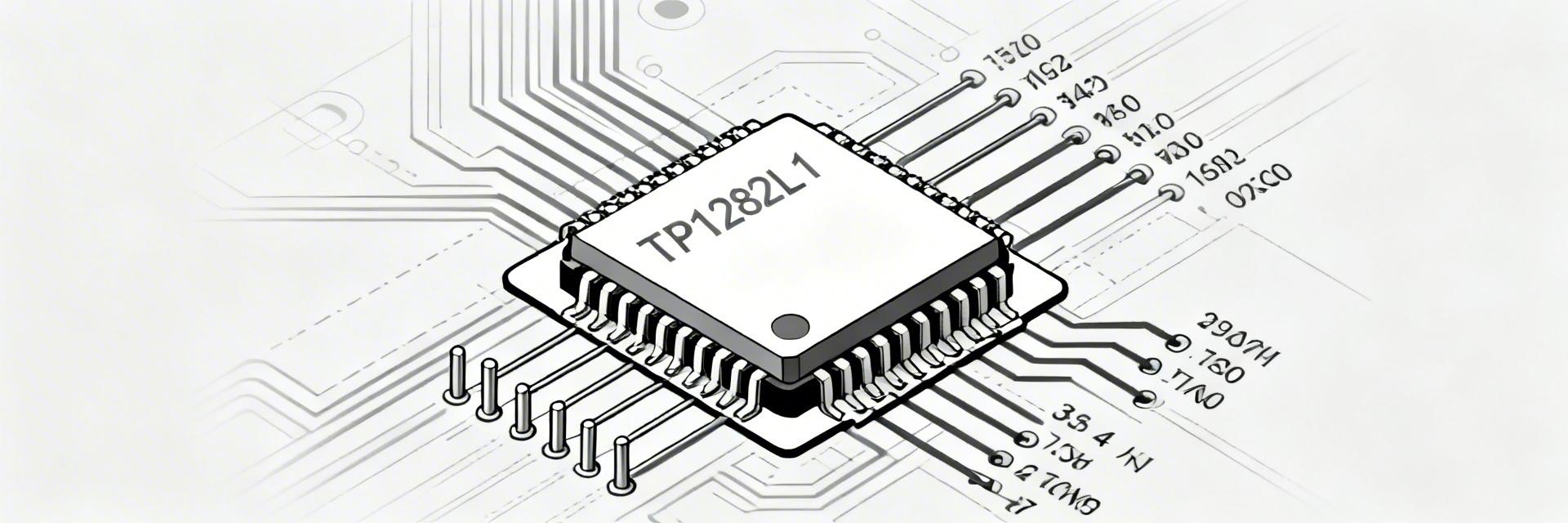
Background: Where TP1282L1 Fits in High-Voltage Precision Designs
Architecture & Core Features
Core Principle: The device uses a CMOS-based precision amplifier architecture optimized for single-supply high-voltage use.
Impact: Low offset and rail-to-rail I/O permit direct interfacing to sensor outputs without level translators, simplifying BOM for battery or vehicle-derived supplies.
Typical Use Cases
Target: Single-supply amplifiers, comparator-style thresholding, and instrumentation front-ends.
Context: Ideal where voltage headroom and low offset trump ultra-high bandwidth—e.g., high-side current sensing or precision ADC buffers.
Quick-spec Snapshot (At-a-glance)
| Parameter | Typical | Maximum / Notes |
|---|---|---|
| Supply Range | ~4.5 V to 36 V | Absolute max per datasheet |
| Input Common-mode | Rail-to-rail | Includes ground; check high V+ headroom |
| Output Swing | Tens of mV from rails | Degrades with heavy load |
| Offset Voltage (Vos) | ~0.2 mV | ≤1 mV (max) at test conditions |
| Input Bias Current | pA–nA range | See temperature curves |
Electrical Characteristics Deep-Dive: DC & AC Behavior
DC Parameters: Offset, Bias, & Swing
Offset and input bias define systematic error for small signals. With a typical Vos of ~0.2 mV and worst-case ≤1 mV, accuracy is high. Example: For a 100 mV sensor span, a 0.5 mV offset represents a 0.5% error. Compensation strategies include offset-trim resistor networks with a DAC, ac-coupling, or digital calibration.
AC Parameters: Gain Bandwidth, Slew Rate, & Stability
GBW and slew rate determine closed-loop performance. For a target closed-loop gain of 10 and required bandwidth of 100 kHz, ensure GBW ≥1 MHz. For comparator-style transitions, watch slew-rate limits to avoid unexpected propagation delays. In low-impedance wideband sensors, consider noise density to balance gain vs. bandwidth.
TP1282L1 Pinout & Package Details
Pin Map Guidelines
- • Power: Wire V+ and ground with local decoupling (0.1 µF + 10 µF) within 2–3 mm.
- • Inputs: Tie unused inputs per datasheet; avoid leaving high‑impedance floating nodes.
- • Thermal: Solder exposed pads to PCB ground and add thermal vias.
Package Variants
Available in small-outline and SOT variants. For power dissipation above a few tens of mW, utilize the exposed pad and increase copper pour to reduce junction-to-ambient thermal resistance (thetaJA).
Typical Application Circuits & PCB Tips
Worked Example: Non-Inverting Gain
Gain = 1 + R2/R1
For a gain of 11, choose R1 = 10 kΩ and R2 = 100 kΩ. If GBW is 1 MHz, expected closed-loop bandwidth ≈ 1 MHz / 11 ≈ 90 kHz. Always verify output swing headroom with your specific RL (e.g., 10 kΩ).
PCB Layout Checklist
Design Checklist & Troubleshooting
Common Failure Modes
Oscillation: Often caused by long leads or capacitive loading. Fix: Add a small feedback capacitor (pF range).
Clipping: Occurs when exceeding input common-mode limits. Fix: Verify rails and source impedance.
Verification Tests
Step Response: Capture settling for slew-rate and stability checks.
Sweep Tests: Measure offset across the full operating temperature range and input common-mode sweep.
Summary
- The device offers a wide supply range and rail-to-rail I/O with microvolt-class offset; validate Vos (typ vs max) and input common-mode limits before system integration.
- Key numbers to check: supply range, Vos, output swing under load, and GBW/slew rate for specific closed-loop gains.
- Top layout actions: tight decoupling at V+, guard high‑impedance nodes, and use thermal vias on exposed pads.