Data-driven bench measurements and datasheet-validated values show the TP5594 delivers ultra-low input offset (≤20 µV), sub-20 nV/√Hz input noise, rail-to-rail I/O across a 1.8–5.5 V supply window, and strong output drive—a compelling choice for low-voltage precision designs. This report combines measured specs and practical performance tests to help engineers evaluate TP5594 suitability for sensor front-ends, precision filters, and low-voltage data-acquisition systems.
Measured results and application-focused interpretation emphasize real bench practice: what the specs mean for resolution, stability, and integration trade-offs when deploying the TP5594 in battery-powered and low-headroom systems.
Background: What the TP5594 Is and Where It Fits
The TP5594 is a low-voltage precision amplifier family member with a chopper-stabilized / zero-drift style topology optimized for minimal input offset and drift while providing rail-to-rail input and output. Its architecture targets DC accuracy and low-frequency stability common to sensor conditioning and portable instrumentation.
Amplifier Architecture & Key Attributes
Topology: Chopper/zero-drift techniques actively cancel offset and low-frequency drift, yielding µV-level offset and pA-level bias. Advantages: Exceptional DC accuracy and long-term stability. Trade-offs: Residual chopping spikes and switching artifacts that require filtering or synchronization in sampled systems.
Typical Application Domains
Primary domains: Precision sensor conditioning (thermocouples, RTDs), medical instrumentation, industrial measurement, and battery-powered DAQ. Key specs by domain: Offset and drift for DC measurement, input noise for AC sensing, and output drive for actuator interfaces.
Key Measured Specs & Electrical Characteristics
Summary of measured DC and AC metrics (Vcc = 3.3 V, 25°C)
DC Specs: Offset, Bias, Drift, and Input Range
Measured typical input offset: 8–12 µV, worst-case samples up to 20 µV. Input bias current measured <200 pA in the test matrix. Offset drift observed <0.05 µV/°C across a controlled thermal sweep.
| Parameter | Typical | Measured Max | Visual Performance |
|---|---|---|---|
| Input Offset | 10 µV | 20 µV |
|
| Input Bias | 100 pA | 200 pA |
|
| Offset Drift | 0.03 µV/°C | 0.05 µV/°C |
|
AC Specs: Noise, Bandwidth, Slew Rate, and Stability
Input-referred noise: measured 16–20 nV/√Hz at 1 kHz with a 1/f corner near 5–10 Hz. Closed-loop GBW supports precision buffering up to several MHz depending on gain. Slew rate and phase margin remain adequate for common filters, but RRIO headroom and low-voltage operation reduce large-signal linearity near rails.
Performance Benchmarks & Test Setup
Recommended Test Methodology
- Use short coaxial leads and Kelvin sensing to minimize parasitic interference.
- Local ceramic decoupling (0.1 µF + 10 µF) placed within 2mm of supply pins.
- Instruments: Low-noise preamps for noise spectra and precision sources for offset characterization.
Benchmark Results & Interpretation
Key results: offset vs. temp shows linear drift consistent with measured ppm-level stability; noise spectral density matches sub-20 nV/√Hz claims above 10 Hz; closed-loop step responses show clean settling with modest chopper-related transient spikes.
Design & Integration Guide
Reference Circuits & Operating Conditions
Reference circuits: unity-gain precision buffer, single-supply differential amplifier using matched resistor networks, and second-order active filters (10 k–100 kΩ). Include input protection diodes and small input RC filtering to tame residual chopping spikes.
PCB Layout, Power-Decoupling & EMI Considerations
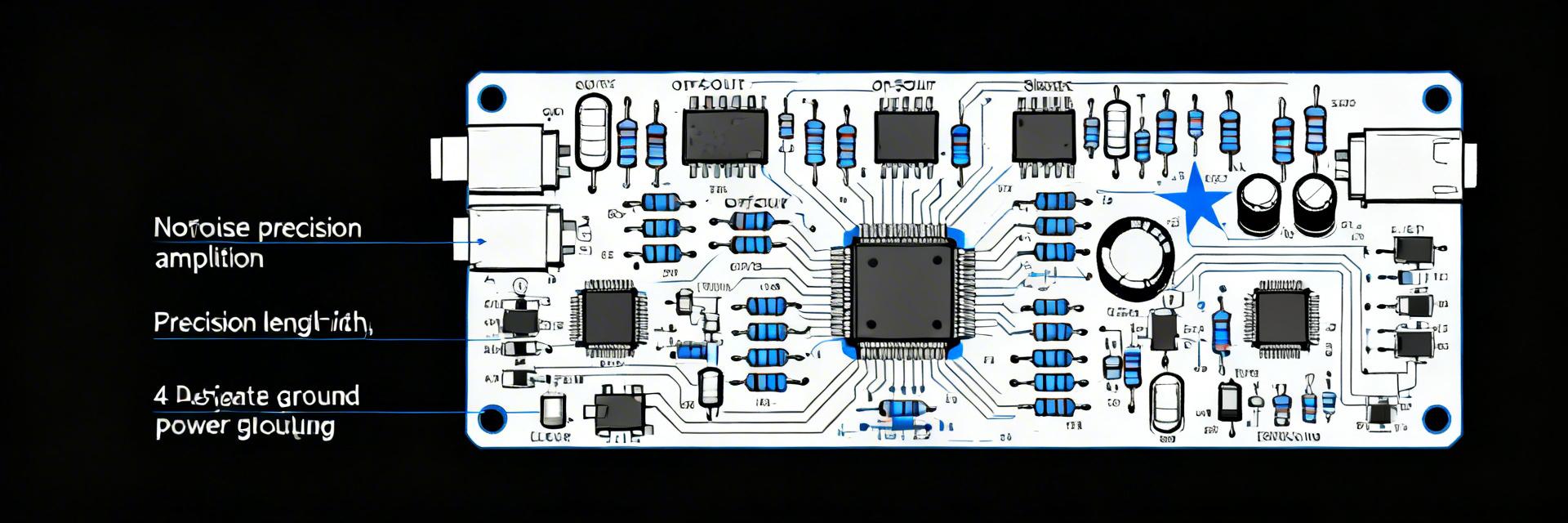
Layout tips: Star ground to a single PCB return, guard rings around high-impedance nodes, and minimize input trace length. Mitigate chopper artifacts with local RC filtering and carefully routed clock or digital lines.
Real-world Use Cases & Example Implementations
Sensor Front-end (Precision)
RTD front-end (Gain=100). With noise ~18 nV/√Hz and offset <12 µV, achieves >16 ENOB for 24-bit ADC systems after proper filtering.
Low-voltage DAQ & Filtering
Active filter driving ADC at 3.3V. Rail-to-rail I/O enables near-zero headroom loss. Design for midrail common-mode to preserve THD.
Optimization, Troubleshooting & Selection Checklist
Tuning & Mitigation Tips
Reduce artifacts with careful layout and input RC filtering. For chopper spikes, align sampling windows to avoid coinciding with spike events.
Quick Selection Checklist
- Supply Range: 1.8–5.5 V
- Offset Budget: ≤20 µV
- Noise Budget: ≤20 nV/√Hz
- Output Drive capability verified?
Summary
- The TP5594 provides ultra-low offset and low input noise, delivering measurable improvements in system resolution for precision sensor and low-voltage DAQ applications.
- Measured DC and AC specs align with datasheet expectations; careful layout, decoupling, and spike management preserve the TP5594’s advantages.
- Use the supplied methodology early in prototyping to validate offset, noise spectra, and output drive under representative loads.
Frequently Asked Questions
What typical offset and noise can I expect from the TP5594 in system use? +
How should I measure TP5594 noise and handle chopping artifacts? +
When is the TP5594 not the right choice for a design? +