TP2121 Datasheet Deep Dive: Key Specs & Pinout Analysis
2026-01-25 12:53:07

Core Insight: The TP2121 occupies the nanowatt-class niche, with per-amplifier supply current specified around 600 nA typical and up to 950 nA max.

Objective: This analysis translates datasheet metrics into concrete design decisions for low-power analog front ends.

Background: What the TP2121 Is and Where It Fits

TP2121 Datasheet Deep Dive: Key Specs & Pinout Analysis
Product Class & Core Strengths

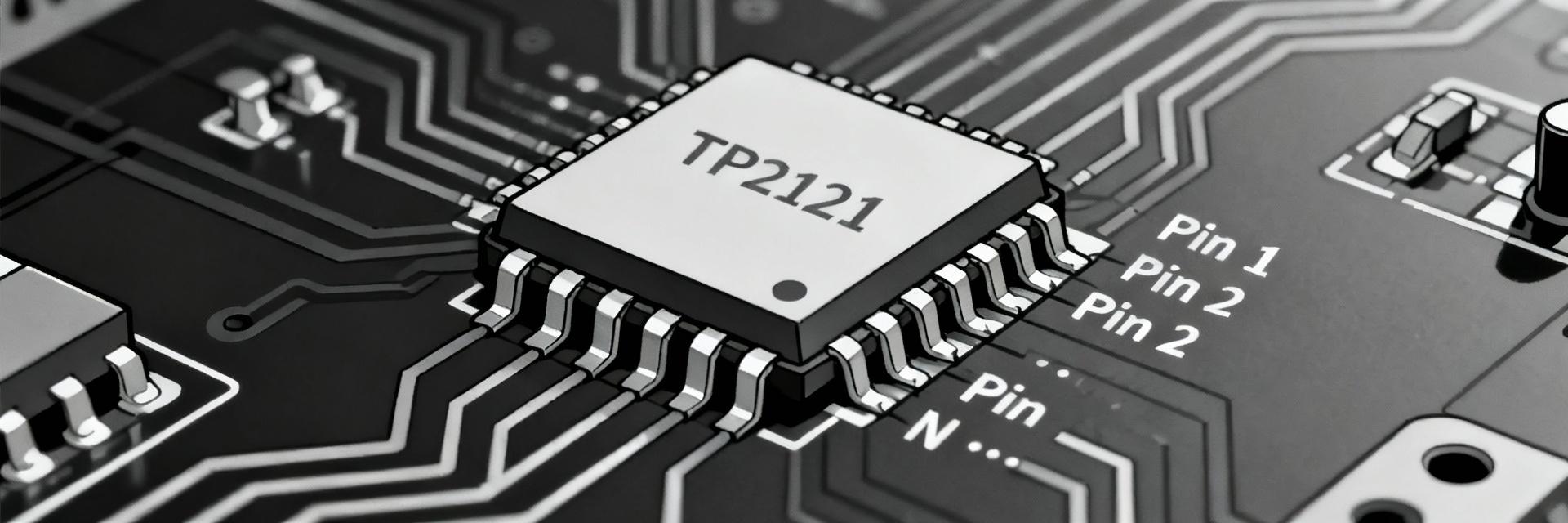
The TP2121 is an ultra-low-power CMOS precision operational amplifier designed for always-on sensor interfaces. Its nanowatt-class quiescent current and rail-to-rail behavior make it ideal for battery-powered temperature or strain sensors.

Typical Operating Conditions

Specified across a wide low-voltage supply window, it supports single-cell battery operation while preserving input common-mode and output swing margins for maximum signal integrity.

Key Electrical Specs: Interpreting the Numbers

Parameter Typical / Target Design Note & Visualization
Supply Current ~600 nA / 950 nA max
Power Budgeting
GBWP ~18 kHz
DC to low-kHz filters
Slew Rate ~10 mV/µs Limits fast transient response
Offset Voltage Sub-mV Precision signal conditioning

Dynamic Performance Note: High closed-loop gains reduce usable bandwidth. Pick gains so the closed-loop bandwidth remains well below GBWP/G to maintain stability margins.

Pinout & Electrical Mapping

  • Functional Map: Includes V+, V-/GND, Non-inverting/Inverting inputs, and Output.
  • ESD Protection: Plan for ESD diodes or series resistors at inputs when exposed.
  • Signal Limits: Ensure sensor signals remain inside the common-mode window to avoid rail saturation.

PCB Layout Best Practices

  • Grounding: Use a solid ground plane to minimize noise and stability issues.
  • Bypassing: Place a 0.1 µF bypass capacitor within 1–2 mm of the V+ pin.
  • Routing: Route input traces short and shielded to avoid star routing return paths.

Application Examples & Configurations

Low-Power Sensor Front End

Typical single-supply sensor amplifier uses R values (100 kΩ–1 MΩ) to keep input bias currents negligible. Recommended gain of 10–50 for DC-oriented sensors.

Energy-Harvested Monitor

Configured as a comparator with hysteresis to conserve power. Feedback networks should be high-value to minimize current consumption during threshold detection.

Troubleshooting & Validation Checklist

Common Pitfalls
  • Instability (ringing/oscillation)
  • Unexpected DC offset drift
  • Excessive current draw near rails
Lab Setup
  • Low-noise power supply
  • Short grounding probe tips
  • AC small-signal sweep for GBWP

Frequently Asked Questions

What supply voltages are recommended for the TP2121?
Use supply voltages within the device's rated window that keep the input common-mode clear of the rails for expected sensor swings. Pick the lowest supply that preserves headroom to maximize battery life.
How should I interpret the TP2121 pinout in schematics?
Map physical pins to functions: V+, V-/GND, +IN, -IN, and OUT. The pinout guides the placement of bypass capacitors and input protection; ensure decoupling is adjacent to V+ and keep input pins isolated from noisy traces.
What are quick lab checks to verify datasheet specs?
Measure quiescent current per amplifier with floating inputs/outputs. Sweep a small AC stimulus through a known closed-loop gain to confirm the -3 dB point and infer the Gain-Bandwidth Product (GBWP).

Summary

  • The TP2121 provides nanowatt-class consumption (~600 nA) with 18 kHz GBWP for long-life battery systems.
  • Designers must balance current budget per channel and avoid excessive capacitive loads to maintain stability.
  • Optimal layout requires precise decoupling placement and short signal paths to leverage the amplifier's precision.