The TPA6584-SO2R datasheet lists several headline figures that set the device's practical limits: up to 135 mA output per channel, a supply span of 2.7–5.5 V, typical input offset near 100 µV, and an operating range of −40 °C to 125 °C. These numbers establish constraints for power budgeting, thermal routing, and test limits; readers should use the datasheet values to map system-level margins and verify compatibility with ADCs and sensors.
1 — Product Overview & What the Datasheet Actually Lists (background)
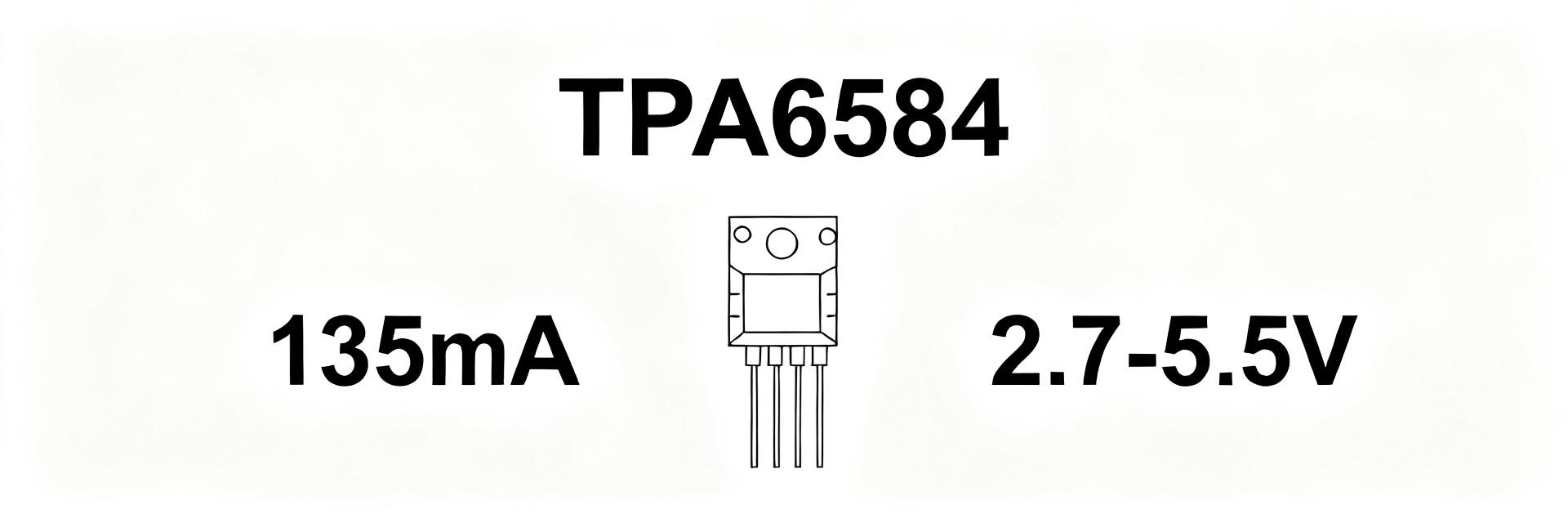
1.1 — Device family, function, and package summary
Point: The device is presented as a multi-channel rail-to-rail I/O amplifier family useful as buffers and sensor drivers. Evidence: the documentation lists topologies, channel counts, intended use cases, and multiple package options with pinouts. Explanation: designers must confirm whether the specific SKU is single, dual, or quad and check pinout differences on the datasheet to avoid layout mismatches and ensure correct decoupling and thermal pads.
1.2 — Electrical operating envelope (high-level)
Point: The electrical envelope constrains supply, temperature, and quiescent current for system budgeting. Evidence: the datasheet specifies a 2.7–5.5 V supply span, −40 °C to 125 °C operating range, and a typical multi-channel supply current around 1.2 mA. Explanation: those figures drive battery life and thermal headroom calculations; for battery-powered designs, the low quiescent current helps, but peak output draw and derating at temperature determine real-world runtime.
2 — TPA6584-SO2R: Electrical Key Specs (datasheet numbers) (data-analysis)
2.1 — Core DC specs to evaluate
Point: Key DC specs to vet are input offset, input bias, common-mode range, and output swing. Evidence: the datasheet lists a typical input offset near 100 µV, input bias currents in the pico/nanoamp range, and rail-to-rail input/output performance limits. Explanation: compare offset and bias to ADC LSB and sensor source impedance—100 µV offset matters for high-resolution ADCs; ensure common-mode stays inside specified window to avoid nonlinearities.
2.2 — Output drive, supply and thermal figures
Point: Output current capability and thermal behavior determine load and reliability limits. Evidence: the datasheet rates up to 135 mA per channel and shows supply current scaling with active channels plus thermal derating curves. Explanation: at higher continuous loads heat buildup forces derating; designers must calculate amplifier power dissipation and ensure PCB copper and vias remove heat to keep junctions within safe limits.
| Example | Values |
|---|---|
| Scenario | VCC=5 V, Iout=50 mA, Iq≈1.2 mA |
| Approx. amplifier dissipation | P ≈ VCC·Iq + (VCC − Vout)·Iout ≈ 5·0.0012 + (5−2.5)·0.05 ≈ 0.006 + 0.125 = 0.131 W |
3 — Performance Numbers & Interpreting Curves (data-analysis / method)
3.1 — Frequency response, slew rate, and stability
Point: Frequency and phase plots plus slew rate define closed-loop bandwidth and transient response. Evidence: datasheet curves show gain vs. frequency, phase margin, and slew-rate limits that constrain large-signal settling. Explanation: choose feedback components so closed-loop gain keeps the amplifier well below unity-gain phase rolloff; for higher bandwidth, minimize feedback capacitance and use lower resistance values while watching noise trade-offs.
3.2 — Noise, distortion, and precision metrics
Point: Noise and THD specify whether the amplifier suits precision or audio paths. Evidence: the datasheet provides input-referred noise density and THD vs. frequency plots that let you budget SNR. Explanation: integrate noise density across your signal band to compute RMS noise and compare against ADC LSB size; if THD and noise exceed system budgets, add filtering or select a lower-noise topology.
4 — Typical Application Circuits & Real-World Measurements for TPA6584-SO2R (case study)
4.1 — Common application examples to replicate
Point: Typical application circuits are unity-gain buffers, followers for sensor interfaces, and low-side or high-side drivers with load testing. Evidence: the datasheet shows sample schematics with expected offsets, gain error, and supply current under representative loads. Explanation: on bench builds verify offset, gain error, and supply current: measure offset with near-zero input, confirm gain within quoted percent, and load each channel to expected current while watching supply and temperature.
4.2 — Bench test plan & measurement pitfalls
Point: A systematic bench plan reveals true device behavior and traps to avoid. Evidence: recommended steps include supply sequencing, decoupling verification, incremental load testing up to 135 mA, thermal soak, and offset checks under load. Explanation: common pitfalls are probe loading, insufficient decoupling, and current-limited supplies; use proper current limiting and Kelvin sense when measuring low offsets.
- Verify pinout and decoupling per datasheet before power-up.
- Bring supplies up slowly; check quiescent current.
- Measure offset with low-noise instrumentation and short leads.
- Apply load increments to 135 mA; monitor VCC, temp, and offset shift.
- Thermal soak for steady-state behavior and derating verification.
- Check stability with intended feedback components and cable/probe capacitance.
5 — Practical Selection & Implementation Checklist (actionable)
5.1 — Selection checklist (before you pick the part)
Point: A concise pre-purchase checklist reduces redesign risk. Evidence: cross-checkes from the datasheet include supply rails, per-channel output current, package/pinout, temperature range, and precision/noise specs. Explanation: confirm that supply margin, required 135 mA peak or continuous drive, and thermal considerations match system needs; if any item is marginal, evaluate alternative topologies or heatsinking strategies.
5.2 — PCB layout, thermal, and reliability tips
Point: Layout and thermal strategy materially affect performance at high output currents. Evidence: datasheet guidance plus typical best practices favor close decoupling, thermal vias, short load traces, and ample copper for heat spreading. Explanation: place bypass caps within 10 mm of supply pins, use low-ESR ceramics, route high-current traces as short, wide runs, and include thermal vias under exposed pads when the package and documentation permit.
Summary
Recap: the datasheet highlights a 2.7–5.5 V supply span, up to 135 mA output per channel, low input offset (~100 µV), and a wide operating temperature window; these numbers drive power, layout, and test decisions. Use the electrical envelope for budgeting, apply the bench test plan to verify behavior under load, and implement PCB thermal measures to prevent derating and ensure reliable operation.
Key Summary
- Supply & thermal constraints: The 2.7–5.5 V range and −40 to 125 °C operating window determine battery and thermal margins; size copper and vias so continuous loads near 135 mA do not exceed device derating curves or junction limits.
- Drive & dissipation: Up to 135 mA per channel requires power dissipation checks; use quick PD ≈ VCC·Iq + (VCC−Vout)·Iout calculations to estimate heating and design PCB heat spread accordingly.
- Precision considerations: Typical input offset around 100 µV mandates low-noise layout and measurement technique for high-resolution ADC interfacing; verify common-mode and input bias against system sources.
- Bench verification: Follow a phased test plan—check pinout, decoupling, incremental loading, thermal soak, and offset under load—to catch probe and PCB parasitic effects early.