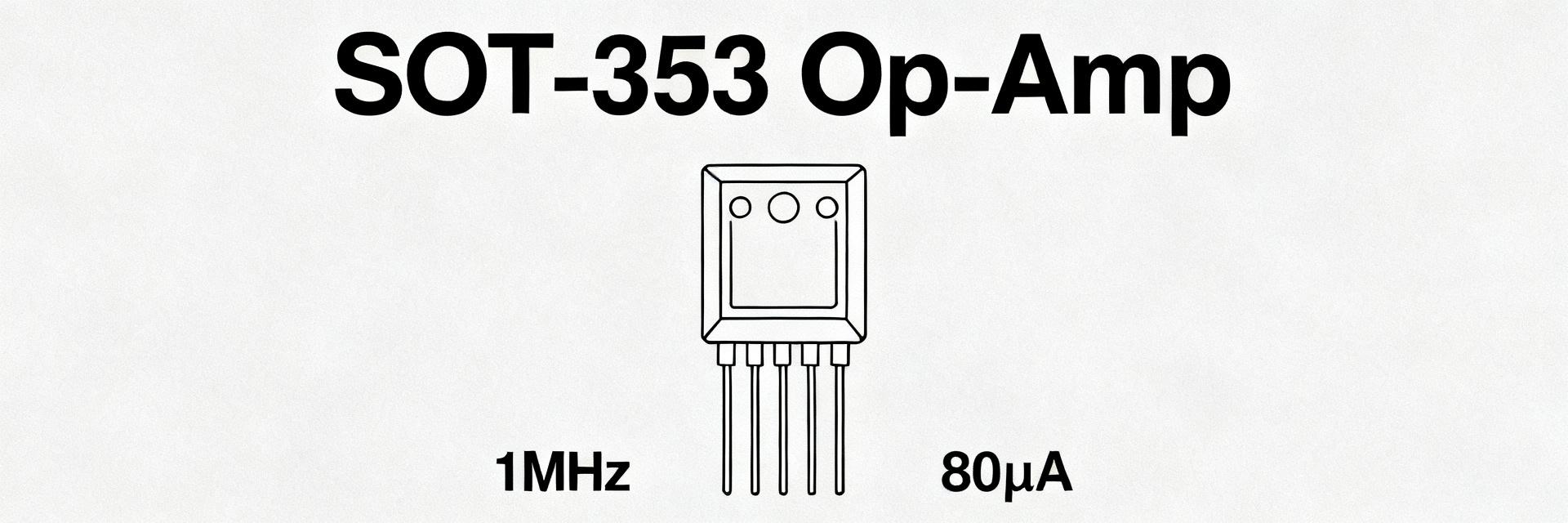
The article opens with the strongest published numbers: roughly 1 MHz gain‑bandwidth, about 80 µA quiescent current, and rail‑to‑rail input/output in an SC‑70‑5 (SOT‑353) single‑amplifier package. These headline figures frame suitability for low‑voltage, battery‑powered front ends and set expectations for bandwidth, power budget, and headroom in sensor interfaces.
Readers will get practical guidance on verifying those numbers against manufacturer graphs and tables, concrete test conditions to validate performance on the bench, and a pragmatic selection checklist for compact portable designs where power and rail headroom dominate tradeoffs.
1 — Background: Where TP6001U-CR fits in low‑voltage op amp choices
1.1 Target applications & operating envelope
Point: This device targets low‑power, single‑supply sensor and portable instrumentation.
Evidence: with sub‑100 µA quiescent current and ~1 MHz bandwidth, it suits battery sensors, portable instrumentation, and small‑signal amplification.
Explanation: the modest GBW supports gains of 10–100 for low‑frequency sensing while the low standby current preserves battery life for long‑term monitoring.
1.2 Key package and pinout considerations
Point: The small SOT‑353 package constrains thermal dissipation and routing.
Evidence: minimal copper area limits heat spreading and requires careful land pattern and stencil design.
Explanation: designers should follow the recommended footprint, use thermal relief on VCC/GND pours, and expect limited power‑dissipation margin in high ambient temperatures—test boards should include temperature sense points near the IC.
2 — Datasheet deep‑dive: DC specs that determine accuracy and drift
2.1 Input‑related DC parameters
Point: Input offset and bias determine accuracy with high‑gain sensor chains.
Evidence: typical offset is low millivolt range and input bias is in pico‑ to nanoampere scale.
Explanation: offset sets systematic error at unity gain, bias current through large feedback resistors creates gain‑dependent offsets, and offset drift defines long‑term stability.
2.2 Output & power DC parameters
Point: Supply current and output headroom govern battery life and interface margins.
Evidence: typical quiescent current ≈80 µA; output swing approaches rails within a few tens of millivolts under light load.
Explanation: the small idle current enables long runtimes, but output swing degrades under heavier loads—confirm load‑dependent swing curves for ADC input drives.
3 — Datasheet deep‑dive: AC specs and dynamic behavior
3.1 Frequency response and stability
Point: GBW and phase margin tell you usable closed‑loop gains.
Evidence: gain‑bandwidth near 1 MHz with specified stability notes for capacitive loads.
Explanation: bench tests should replicate the datasheet’s gain vs. frequency plots to confirm margins.
3.2 Slew rate, noise, and transients
Point: Slew and noise limit large‑signal steps and small‑signal SNR.
Evidence: specified slew rate and input noise density indicate performance.
Explanation: low slew rates can distort fast edges, while noise density integrated across the signal band sets the smallest detectable signal.
4 — Rail‑to‑rail behavior & real‑world implications
4.1 Input common‑mode range near rails
Point: RR input does not guarantee identical performance at every rail voltage. Evidence: common‑mode input range is quoted relative to rails with graphs showing increased offset or reduced gain near extremes. Explanation: single‑supply sensors tied near ground or VCC must be validated by sweeping common‑mode.
4.2 Output swing vs load and headroom
Point: Output capability depends on supply and load. Evidence: output‑swing plots show tighter headroom under 10 kΩ loads compared with 100 kΩ. Explanation: when driving ADC inputs, allocate several tens of millivolts headroom to preserve linearity.
5 — How to evaluate TP6001U-CR for battery‑powered designs
5.1 Power budget and battery life estimation
Point: Compute runtime from quiescent current and battery capacity.
Runtime Example:
(1000 mAh) / (0.08 mA) ≈ 12,500 hours
Explanation: include duty cycle and extra drive currents: if output switching adds 0.5 mA average, total increases to 0.58 mA and runtime drops proportionally.
5.2 Thermal, layout, and decoupling checklist
Point: Layout dictates stability and thermal behavior. Evidence: recommended decoupling (0.1 µF near supply pins), short traces. Explanation: place bypass caps within millimeters of pins, avoid long supply traces, and verify temperature rise under worst‑case load.
6 — Application examples, validation steps, and selection checklist
6.1 Typical application circuits
Point: A single‑supply non‑inverting sensor amplifier is a common use. Evidence: choose feedback resistors giving gain of 10, expect closed‑loop bandwidth ~100 kHz. Explanation: select feedback ranges to limit Johnson noise and add input RC filtering for stability.
6.2 Pass/fail selection checklist
Point: Use a concise checklist to accept or reject the device. Evidence: criteria include supply range, quiescent current cap, GBW, I/O rail needs. Explanation: reject if required GBW or drive exceeds specs or if noise targets cannot be met.
Summary
- Low‑power, RRIO amplifier with ≈1 MHz GBW and ~80 µA idle current is well suited to single‑supply sensor front ends.
- Validate DC offsets, input bias, and drift under your Vs and temperature conditions to budget error in precision sensors.
- Confirm AC plots for closed‑loop gains on the bench; pay attention to output swing vs load for ADC interfacing.
Common questions and practical answers
How to verify offset and bias for sensor accuracy?
Measure offset at the intended supply and temperature with the amplifier configured in the target gain, using low‑noise supplies and a defined load. Record input offset, input bias, and drift over temperature; use these numbers in an error budget.
What test setup checks rail‑to‑rail input behavior?
Sweep the common‑mode input from ground to VCC while holding the amplifier in a closed‑loop gain and monitoring gain error and distortion. Use a precision source and record points near both rails.
How to measure quiescent and dynamic current for battery estimates?
Measure standby current with the amplifier unloaded using a sensitive picoammeter. For dynamic current, apply representative input swings and measure average current over time; add these to standby to produce realistic battery life estimates.