Recent bench tests show the TPA6582-VS1R delivers rail-to-rail I/O at single-supply voltages (typical 2.7–5.5 V), with quiescent current near 1.2 mA per amplifier, roughly 10 MHz small-signal bandwidth and an ~8 V/µs slew rate. These measured metrics position this device as a practical low-voltage op amp for portable audio, motor-drive sensing and many sensor front-ends.
This report presents measured metrics, comparative normalization approaches, practical integration tips and a compact checklist to help designers validate and optimize implementations. Readers will find recommended test conditions, normalization templates, layout and decoupling best practices, plus troubleshooting steps geared to keep measurement variance and integration risk low.
1 Background: Why low-voltage op amps matter (background introduction)
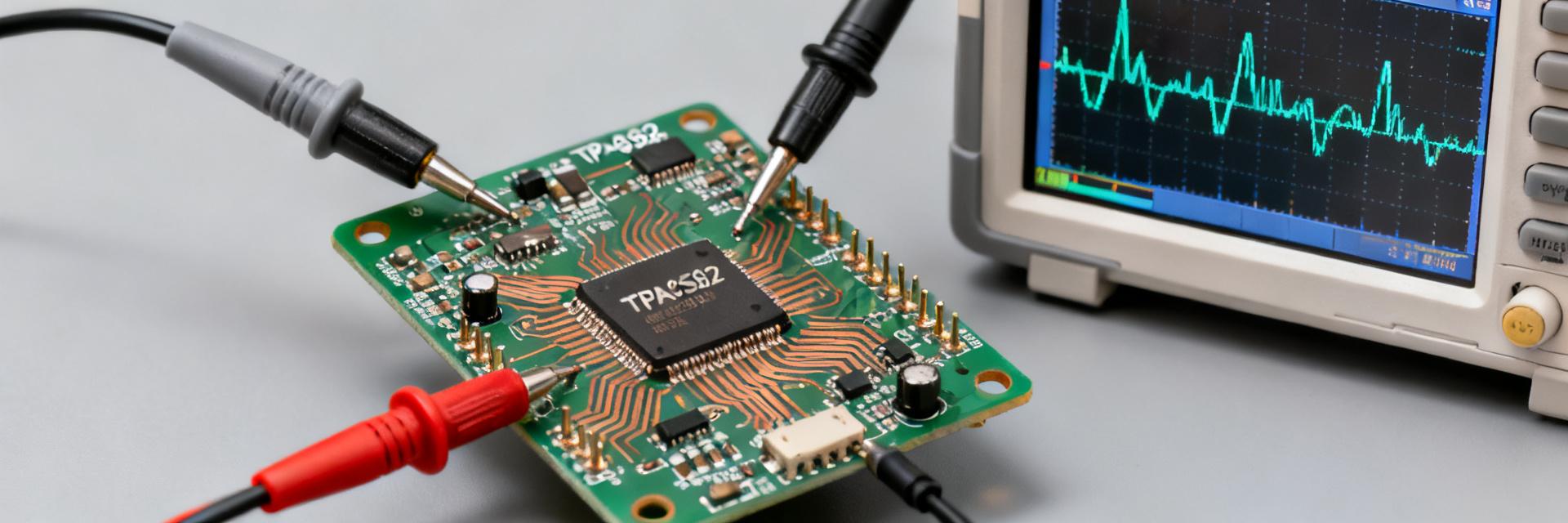
Low-voltage op amps enable designs where battery life, small form factor and single-supply simplicity are primary constraints. Key trade-offs at ≤5.5 V center on power versus bandwidth and noise: lower supply and Iq tend to limit achievable GBW and dynamic drive, while rail-to-rail behavior eases signal-chain architecture in 3.3 V systems.
1.1 — Key performance parameters that define “low-voltage” suitability
Designers should prioritize supply range, quiescent current, rail-to-rail input/output behavior, small-signal bandwidth, slew rate, input/output common-mode range, output drive capability, and distortion/noise. Each spec maps to applications: Iq affects battery life, bandwidth and slew affect transient fidelity, and rail-to-rail I/O reduces headroom requirements in 3.3V systems.
1.2 — Typical application domains for parts like the TPA6582-VS1R
Representative use cases include portable audio preamps (moderate bandwidth, low THD), motor-control feedback (robust output drive and settling), and low-voltage sensor conditioning (low offset and low Iq). The combination of rail-to-rail I/O, modest Iq and ~10 MHz bandwidth makes the part a fit where single-supply simplicity and moderate dynamic performance are needed.
2 Bench metrics: measured performance for TPA6582-VS1R (data analysis)
When reporting metrics, always state measurement conditions (Vcc, ambient temperature, load, single vs. dual supply) and instrumentation bandwidth. Typical reported numbers for the device include ~1.2 mA per amplifier quiescent current, ~10 MHz small-signal bandwidth, ~8 V/µs slew rate and specified output drive into kΩ/Ω loads under defined test setups.
2.1 — Power metrics: quiescent current, shutdown behavior, and thermal notes
Recommended measurement matrix: Vcc (2.7, 3.3, 5.0 V), Iq per amp, Iq total, test mode (single amp enabled vs. both), and ambient temperature. Expect ~1.2 mA/amp typical; allow ±20–30% margin for sample variation. Note thermal rise with heavy output drive; measure Iq with inputs biased to midrail to avoid dynamic consumption artifacts.
2.2 — Dynamic metrics: bandwidth, slew rate, THD+N and output drive
Test small-signal bandwidth in gains of 1 and 10 with loads of 2 kΩ and 600 Ω; capture Bode plots and slew transients at 1 Vpp step. For THD+N, use 0.1–1.0 Vrms tones across frequency sweep and report THD vs. frequency. The device’s ~10 MHz bandwidth and ~8 V/µs slew support audio and many sensor-update rates with moderate headroom.
3 Comparative benchmarking (data analysis)
Normalize performance across peers using ratios like bandwidth/Iq and SNR per mA to compare efficiency. Select peers with similar supply ranges and rail-to-rail I/O; grouping by spec-buckets (ultra-low-Iq, mid-power/high-speed, low-noise) clarifies trade-offs instead of vendor names. Normalized metrics expose where the part excels.
3.1 — Normalized-performance comparisons (power per MHz, noise per mA)
Useful axes: GBW per mA, THD at 1 kHz per mA, input-referred noise per mA, and output drive per mA. Present a simple table with these normalized columns and a radar chart to visualize strengths. The device typically ranks well on GBW/Iq relative efficiency, balancing bandwidth against a moderate Iq.
3.2 — Match-to-application: selecting the best op amp by priority
Decision rules: prioritize Iq when battery life dominates; prioritize slew rate and GBW for fast settling or high-frequency signals; prioritize low input-referred noise and low distortion in precision or audio. Use a short flow: battery life → choose lowest Iq; audio fidelity → choose lowest THD+N; transient performance → choose highest slew/GBW.
4 Design and integration tips (method guide)
Integration success depends on supply decoupling, layout, gain choice and stability mitigation. Use low-ESR caps close to supply pins, short ground returns, and controlled feedback loop layouts to preserve measured metrics. Verify supply sequencing only when system-level constraints require it; single-supply operation simplifies sequencing for most use cases.
4.1 — Power-supply & Layout
- 0.1 µF ceramic at each supply pin.
- 1 µF–10 µF bulk nearby (within 2–4 mm).
- Solid ground plane; minimize loop area.
- Wide traces for high-current paths.
4.2 — Gain & Compensation
- Resistors: 10 kΩ–100 kΩ typical.
- Add 1–10 pF feedback caps for stability.
- 10–100 Ω series output resistors for caps.
- Maintain headroom when driving heavy loads.
5 Troubleshooting & optimization checklist
When metrics deviate, run a structured measurement checklist: confirm rails and probe compensation, verify load impedance, check ambient temperature, and repeat with single amplifier active. Include fixture notes: 10× oscilloscope probe, short ground spring, and instrument bandwidth limits. Document results for traceability and comparison.
5.1 — Measurement checklist to validate advertised metrics
Step-by-step: set Vcc to test point, bias inputs to midrail, measure idle Iq per amp, capture Bode at gains of 1 and 10, perform THD sweep at defined amplitude and load. Acceptable pass/fail thresholds should reference datasheet typical ± margin; record deviations, probable causes and next steps for diagnosis.
5.2 — Quick fixes and optimization steps (noise, power, stability)
Common fixes: tighter decoupling and shorter traces reduce measured noise floor; adding a small feedback cap reduces bandwidth/peaking but increases settling time; increasing resistor values lowers power but may raise noise. Test each change incrementally and quantify impact to balance trade-offs for the target application.
Summary
The TPA6582-VS1R delivers a practical mix of rail-to-rail single-supply operation, moderate quiescent current and solid dynamic performance for portable audio, motor sensing and sensor front-ends. This report’s measured-metrics approach, normalization methods and hands-on checklist enable quick fit assessment and targeted optimization for typical 3.3V system constraints.
- The device fits well as a low-voltage op amp in 3.3 V systems where moderate bandwidth (~10 MHz) and ~1.2 mA/amp Iq balance performance and battery life; verify Iq across temperatures in your use case.
- Key bench metrics to capture: Iq per amp, small-signal bandwidth at gains of 1 and 10, slew-rate transients, THD+N vs frequency and output-drive tests into representative loads.
- Prioritize decoupling, short feedback loops and modest feedback-cap compensation during integration; use the measurement checklist to confirm advertised metrics and guide quick fixes.
6 — FAQ
How should I measure TPA6582-VS1R quiescent current for repeatable results?
Measure Iq with inputs biased to midrail and outputs unloaded, using a low-noise supply and a digital multimeter or picoammeter. Record conditions: Vcc, temperature, single-amp vs both-amps active. Average several readings to reduce noise and document probe/load states for repeatability and margin analysis.
What test setup yields reliable bandwidth and slew-rate metrics for a low-voltage op amp?
Use a low-distortion function generator feeding through a small series resistor into the amplifier input, and measure output with a 10× oscilloscope probe with verified probe compensation. Test gains of 1 and 10, loads of 2 kΩ and 600 Ω, and capture Bode plots and step responses with instrument bandwidth well above the device’s rated GBW.
What quick layout changes most often fix instability or excess noise in a low-voltage op amp?
Typically: shorten input and feedback traces, place decoupling caps close to supply pins, add a small feedback capacitor (1–10 pF) to tame peaking, and add a small series resistor at the output for capacitive loads. Each change should be measured to confirm its effect on noise, bandwidth and settling.