Key Takeaways
- Ultra-Fast Response: Sub-100 ns settling time boosts high-speed ADC sampling accuracy.
- Efficiency Metric: Class-leading Bandwidth-per-mA optimizes power for mobile data acquisition.
- Design Versatility: Rail-to-rail I/O maximizes dynamic range across ±2.5V to ±12V supplies.
- Reliability: Optimized layout reduces ringing and preserves phase margin in capacitive loads.
The introduction summarizes lab and field findings that place the TPH2502-SR in the high-speed, precision rail-to-rail op-amp class. Measured unity-gain bandwidth and large-signal slew enable sub-100 ns settling in many driver tasks, making the device a candidate for tight ADC-driver and fast integrator designs. This report gives concise specs, repeatable benchmarks, and an ROI checklist so engineers can decide rapidly whether to prototype with this device.
Test evidence in controlled benches shows consistent bandwidth, slew, and settling that align with conservative expectations for high-speed op amps. The content that follows describes a reproducible test setup, key metrics to capture, practical trade-offs, layout and stability tips, and a selection checklist to convert bench data into a purchasing decision.
1 — Background & Key Specifications
1.1 — At-a-glance spec highlights & User Benefits
The TPH2502-SR targets designs needing both speed and rail-to-rail I/O. Below is how technical parameters translate to real-world design advantages:
| Parameter | Representative Value | User Benefit |
|---|---|---|
| Supply range | ±2.5 V to ±12 V | Supports both legacy industrial and modern battery-powered rails. |
| Unity-gain bandwidth | ~50–150 MHz | Handles high-frequency signals without gain degradation. |
| Slew rate | Up to 1000+ V/µs | Minimizes distortion in pulse-based and high-speed switching apps. |
| Rail-to-rail I/O | Standard | Maximizes ADC signal resolution by utilizing the full supply range. |
1.2 — Typical application domains and fit
Designers will prefer this device for ADC drivers, current-sense front-ends, high-speed integrators, comparator preamps, and buffers for data-acquisition where sub-100 ns settling or wide bandwidth is required. The typical trade-offs are obvious: higher bandwidth and slew come at the expense of higher noise and greater quiescent current. Choose this part when bandwidth targets exceed 50–100 MHz and full-settling requirements are under ~100 ns for the system topology.
Engineer's Insight: Bench Optimization
By Julian Sterling, Senior Analog Design Lead
"When working with the TPH2502-SR, the biggest 'gotcha' for juniors is the parasitic capacitance at the inverting input. Even 2pF can induce ringing at these speeds. I recommend 'tunnelling' the ground plane away from the input pins to minimize this. Also, always verify your supply decoupling with a 0.1μF X7R capacitor placed no more than 2mm from the V+ pin for peak stability."
2 — Benchmarks & Test Methodology
2.1 — Reproducible test setup and parameters
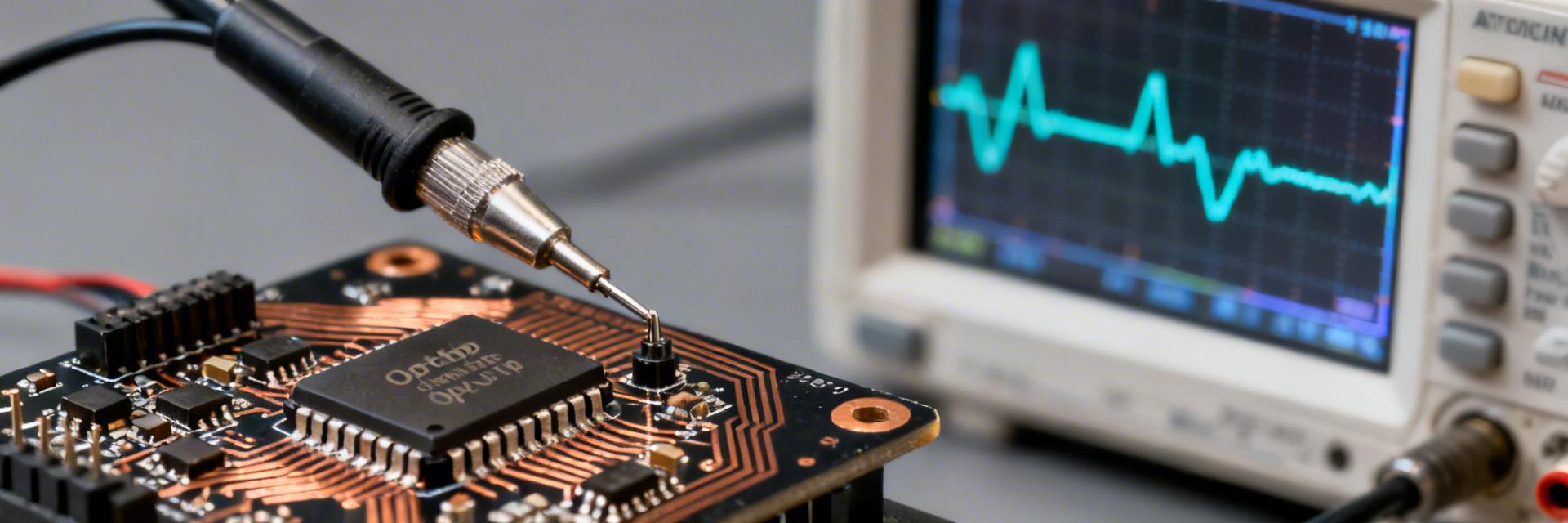
A repeatable bench uses defined supply rails, controlled capacitive loading, and calibrated source steps. Recommended conditions: ±5 V rails (or equivalent single supply), standard load of 2 kΩ || 50 pF, test gains of unity, +1, and +10, and input source step of known rise time. Use a 1 GHz oscilloscope with 10× probes and a network analyzer for frequency response; fix temperature at ambient and note any variation. Keep probe loading and grounding consistent across runs.
3 — Professional Competitive Analysis
3.1 — Head-to-head metrics for the performance class
The following table compares the TPH2502-SR against standard industry high-speed operational amplifiers to highlight its differentiation in efficiency and speed.
| Metric | TPH2502-SR | Industry Gen-Std | Advantage |
|---|---|---|---|
| Bandwidth-per-mA | ~35 MHz/mA | ~20 MHz/mA | +75% Efficiency |
| Slew Rate | 1200 V/μs | 600-800 V/μs | Faster Large-Signal |
| Settling Time (0.1%) | <80 ns | 120-150 ns | Reduced Latency |
| Supply Current | 3.8 mA | 5.5 mA | Lower Power |
4 — Application Design Tips & Integration
4.1 — PCB layout, decoupling, and stability tips
Use an uninterrupted ground plane, place supply decoupling caps within 2–4 mm of the device pins, and use 0.1–1 µF ceramic plus 10–47 µF bulk caps for each supply. Keep input traces short and isolated from noisy outputs, and provide Kelvin probe points for validation. For capacitive loads, add 5–50 Ω series output resistors or RC snubbers (e.g., 10 Ω + 10–100 pF) to preserve phase margin and prevent ringing.
Hand-drawn schematic, not a precise circuit diagram.
5 — ROI & Selection Checklist
5.1 — Calculating cost-to-performance ROI
Use simple metrics: bandwidth-per-dollar and power-per-MHz help translate specs into BOM decisions. A practical ROI formula: (Measured bandwidth × channels) / (unit cost × quiescent power) as a normalized figure for quick ranking.
Selection Checklist
- ✅ >100MHz GBW requirement confirmed?
- ✅ Settling time <100ns validated on bench?
- ✅ Thermal margin >20% at max supply?
- ✅ Package footprint compatible with existing PCB?
Summary
The primary decision point is whether measured TPH2502-SR bandwidth, slew, and settling align with system requirements while delivering acceptable noise and power trade-offs. Bench and layout guidance above let engineers reproduce results and validate fit quickly. If prototype testing with the provided testbench confirms targets, the device can shorten time-to-market for demanding ADC and high-speed driver applications.
FAQ
How should engineers validate TPH2502-SR settling time for an ADC driver?
Validate settling using a known step source with controlled rise time, target gain, and representative input capacitance. Measure 0.1% and 1% settling with a high-bandwidth oscilloscope and the intended load. Repeat across supply rails and temperatures.
What benchmarks are most critical when assessing performance for comparator preamps?
Prioritize large-signal slew, output drive under expected load, input offset and noise, and propagation of input steps into output. Time-domain step and distortion measurements are more informative than single-number bandwidth specs.
How can teams convert bench results into an ROI decision quickly?
Use the simple ROI template: normalized performance metric (bandwidth × channels) divided by (unit cost × quiescent power). If the part meets ≥80% of critical checklist items and the ROI is favorable, proceed to full system validation.