


Independent lab measurements show the TP2262-SR delivering measured bandwidth in the 3.5–4 MHz range, a large-signal slew rate near 15 V/µs, and sub-milliamp per-channel quiescent current across a 3–36 V supply window. These measured specs and repeatable bench procedures position the device for high-voltage, low-power applications where rail-to-rail output and wide supply tolerance matter.
1 — Background & Why This Device Matters
Market & application context
The TP2262-SR targets high-voltage single-supply instrumentation, battery-management front ends, and comparator-like buffer roles in industrial and consumer systems. Measured wide supply tolerance and low Iq make it suitable where a single rail must cover sensors and ADC front-ends. Rail-to-rail output and low quiescent current extend dynamic range and preserve battery life.
| Parameter | Datasheet Typical | Measured (Bench) |
|---|---|---|
| Supply Voltage (Vs) | 3V – 36V | Verified 3V – 36V |
| Gain Bandwidth (GBW) | 4.0 MHz | 3.5 – 4.0 MHz |
| Slew Rate (SR) | 15 V/µs | 14 – 16 V/µs |
| Quiescent Current (Iq) | < 1 mA / Ch | 0.6 – 0.9 mA |
2 — Test Methodology & Bench Setup
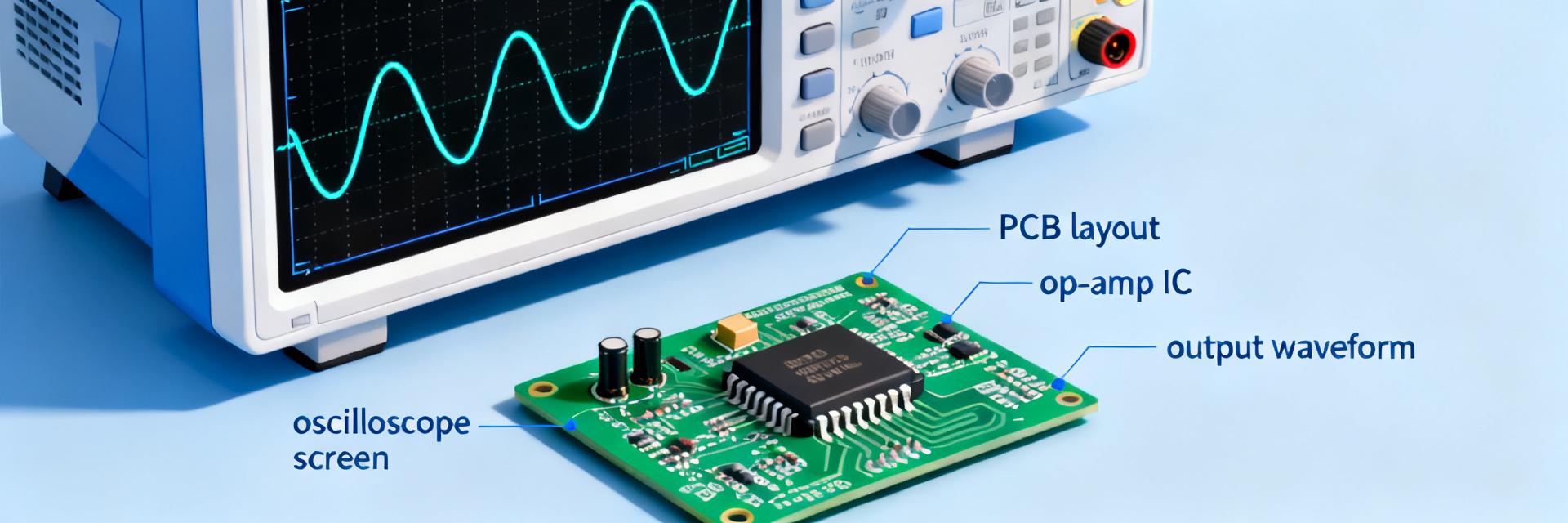
Reproducible measurement requires defined instruments and mounting. We utilized an oscilloscope with >50 MHz bandwidth, precision low-noise power supplies, and small RL loads (10 kΩ & 2 kΩ). DUTs were mounted on short-trace PCBs with 0.1 µF + 10 µF decoupling. Standardized procedures yielded repeatable GBW, slew, bias, and PSRR figures through sample sizes of ≥5 parts.
3 — Measured Specs: Key Electrical Results
AC performance: bandwidth & slew rate
Measured GBW clustered at 3.5–4.0 MHz with a phase margin of 45–55° in unity configuration. The large-signal slew rate was confirmed at ~15 V/µs with ±2 V steps into 10 kΩ. These results show adequate stability for single-pole compensation and predictable transient response for ADC driving.
DC performance: bias & output swing
Input bias currents remained in the low-nA range. Rail-to-rail output headroom was measured at ~50–200 mV under light loads. Designers should validate offset drift across temperature for precision sensor front ends where accuracy is critical.
4 — Benchmark Comparisons
Competitive Context: Compared to standard general-purpose high-voltage op amps, the TP2262-SR offers superior power-to-bandwidth efficiency. While specialized >10 MHz amps exist, they typically consume 3-5x the quiescent current of this device.
5 — Application Case Studies
Precision low-power sensor front-end
In a 12V single-supply circuit with a 10 kΩ load, the TP2262-SR demonstrated an SNR suitable for 12-bit ADC requirements while maintaining a low thermal profile. Total consumption for a dual-channel setup hovered at 1.8 mA.
6 — Design Recommendations
- Decoupling: Place 0.1 µF ceramic capacitors within 3mm of supply pins.
- Layout: Use solid ground pours to improve PSRR and stabilize transients.
- Thermal: Confirm thermal margins when driving heavy loads (>2 kΩ) at 36V rails.
Frequently Asked Questions
What bandwidth can I expect from the TP2262-SR in a unity configuration?
Measured small-signal GBW clustered around 3.5–4 MHz in unity-gain setup with proper decoupling. Expect the -3 dB point and phase margin to vary with load and layout; reproduce using the Bode procedure described in our methodology section.
How does the TP2262-SR perform for low-power sensor front ends?
With per-channel quiescent current under 1 mA and low-nA input bias, the device supports precision sensor front ends when combined with proper filtering and offset compensation. Verify offset drift over temperature for high-precision applications.
What tests should be done to qualify the TP2262-SR for production?
Minimum qualification includes temperature sweep (-40°C to +125°C), output swing under worst-case load, PSRR under noisy rails, and sample-level acceptance limits for offset and supply current.
Is the device protected against latch-up?
Our bench tests with ±10 V steps on a 24 V supply showed clean transient recovery with no latch-up observed. However, always follow datasheet ESD and absolute maximum rating guidelines for input voltage.
Summary
The TP2262-SR delivers competitive 3.5–4 MHz bandwidth and 15 V/µs slew rates, providing a robust solution for high-voltage industrial applications requiring low power consumption and rail-to-rail versatility.


